Learning through Play for Kindergarten Teachers
Collated and edited by Ross Woods, 2026 with thanks to Layda Eko Sulistyani.
Introduction
Choose a form of play that fits the learning
Turn a lesson into learning through play
Examples of converting teacher talk into play
Create pretend situations with a purpose
Help children act out how something happens
Guide learning without taking over the play
Common problems and adjustments
Prepare for safe and inclusive participation
A reusable planning template
Introduction
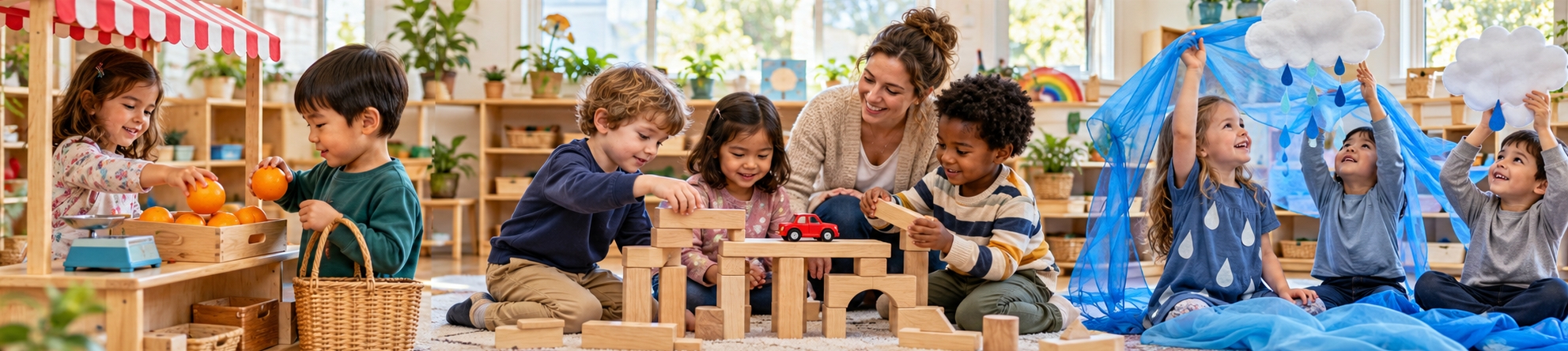
This resource helps kindergarten teachers turn learning goals into activities in which children explore, pretend, build, move, make decisions, and solve problems. It combines practical lesson planning, role play, and activities in which children use their bodies or toys to represent how something happens.
Start with what children should learn. Then create a situation in which they can use that knowledge or skill. Prepare the materials, observe, join the play when useful, and give short explanations or demonstrations when children need them. A brief explanation, shared reading, or demonstration can work well alongside play.
Choose a form of play that fits the learning
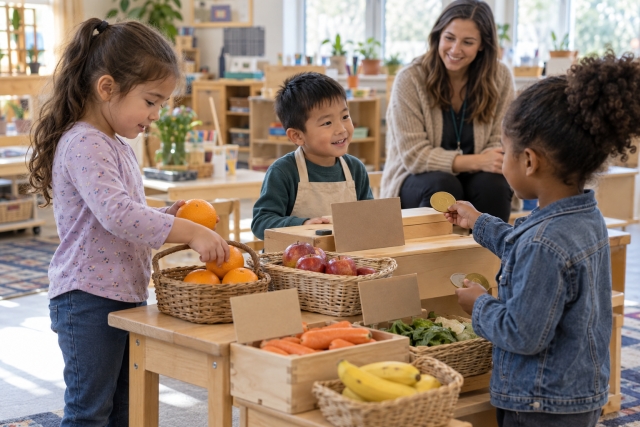
Different learning goals call for different activities. A pretend shop can create reasons to count and communicate. A water tray lets children test ideas. Acting out the journey of water helps children represent a process that they cannot see all at once.
- Pretend situations: Children act as people in a shop, café, clinic, bus, or other setting. They practise communication, cooperation, and skills needed within the situation.
- Exploration and investigation: Children handle materials, predict, test, compare, and try again. Examples include water play, ramps, and experimenting with objects that sink or float.
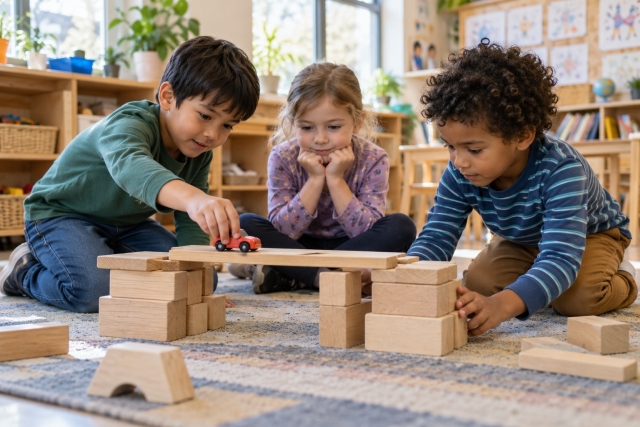
- Construction: Children build something and improve it to meet a purpose, such as a bridge that a toy car can pass under.
- Stories and puppets: Children represent events, develop characters, and retell or invent stories.
- Acting out processes: Children represent water, plants, animals, objects, places, or stages in a process. They show movement, change, sequence, or connections.
These forms can overlap. A building team might construct a bridge, test it, and then use it in a pretend town. Choose one main learning goal so that the extra possibilities do not obscure the intended learning.
Turn a lesson into learning through play
Keep the learning goal when changing the activity. Making a lesson more active is useful only if the new activity still gives children opportunities to learn what you intended.
Step 1. State the learning goal
Describe what children should be able to do: match one cup to each customer, recognise a triangle, retell the main events of a story, or show a simple journey of water. Avoid broad goals such as “learn about nature” when planning a particular activity.
Ask: “What will children do during the play that helps them learn and demonstrate this?”
Step 2. Create an invitation
Offer an interesting situation, material, or problem: open a bakery, help a puppet, build a shelter, or follow a raindrop. Use things children can handle and investigate. A theme is optional; blocks, sand, water, and loose materials can invite play on their own.
Introduce the activity briefly. For example: “Our shop is opening, but the goods are mixed up. How could we arrange them so customers can find what they want?” If the situation is unfamiliar, use pictures, a story, or a short demonstration first.
Step 3. Plan meaningful choices
Let children choose roles, materials, arrangements, routes, or solutions. They need time to try an idea and change it. Handling materials does not by itself make an activity playful. Ask what decisions the children will actually make.
In a science model, children can choose how to represent a process, but the explanation must remain accurate. They may invent a movement for rain; they should not be left with the idea that clouds are made of smoke.
Step 4. Prepare materials and participation
Use simple props: boxes, fabric, blocks, paper, recycled containers, dolls, and toy animals. Children can help make menus, tickets, labels, and signs. Provide enough space and materials to avoid long waits. Small groups often make participation easier.
Offer participation through movement, gestures, pictures, speech, or home-language words. Children can use a seated movement or move a toy instead of travelling around the room. A child who does not want a speaking role might arrange materials, make signs, operate a puppet, or help tell the story.
Step 5. Observe and support
Watch before intervening. Join briefly as a customer, passenger, narrator, or fellow builder. Introduce a useful word, demonstrate something unfamiliar, or offer a problem that connects with the goal. Give children time to respond.
Prepare a few prompts, rather than a continuous stream of questions: “What do you notice?”, “What happened when you tried it?”, “How could we check?”, or “What could we change?” A comment can also help: “You made the base wider, and now the tower stays up.” Give a clear answer when an explanation is needed.
Step 6. Bring the learning together
End with a brief opportunity to show, explain, draw, or repeat something learned. Name the relevant concept and decide what children need next. They may need more play with the same materials, a different example, or a new challenge.
Examples of converting teacher talk into play
Each example below keeps the same main learning goal in the original and play versions.
Predicting and testing sinking and floating
Learning goal: Children predict and test whether objects sink or float.
Teacher-talk version: The teacher places objects in water while children watch, names the result, and asks children to recall which objects sank or floated.
Play version: Provide a shallow water tray, suitable waterproof objects, and pretend rescue figures. Invite children to find objects that stay on the surface and might help with a rescue. Children choose objects, predict, test, and try again.
Teacher support: “What do you think will happen?” “What happened?” Help children use sink and float to describe their observations. Avoid rules such as “heavy things always sink.”
Evidence of learning: A child makes a prediction, tests an object, identifies the result, or changes an idea after testing. An optional extension is to build a raft that supports a figure.
Retelling a familiar story
Learning goal: Children retell the main events in a sensible sequence.
Teacher-talk version: The teacher reads a story, explains what happened, and asks children to recall events.
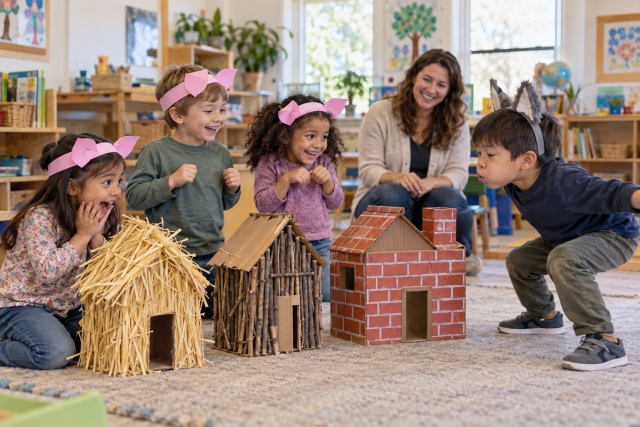
Play version: Keep the shared reading. Then offer puppets, simple props, or costumes. Children choose roles and decide how to represent the main events.
Teacher support: “What happened first?” “How could we show that part?” Welcome an invented ending while helping children distinguish their new version from the original.
Evidence of learning: Children represent the main events in order through acting, gestures, pictures, or speech.
Recognising shapes in a bakery
Learning goal: Children recognise and select circles, squares, and triangles.
Teacher-talk version: The teacher shows shape cards, names the shapes, and asks children to repeat their names.
Play version: Offer playdough, shape cutters, trays, and picture order cards. Children run a bakery and make or select cookies to match customers’ shape orders. Keep colour and counting demands optional.
Teacher support: Join as a customer: “I would like a triangle cookie.” Use a picture if needed, and help children notice the shape’s features.
Evidence of learning: Children select or match the requested shape. Saying its name is one way, but not the only way, to show recognition.
Create pretend situations with a purpose
Choose a familiar situation and one or two learning goals. Provide open-ended props, invite children to help organise the setting, and let them develop the play. Introduce an occasional problem that gives them a reason to use the intended skill.
A worked example of a café
Learning goal: Children match one item to each person and decide whether there are enough.
Materials: A table, dolls or soft toys, cups, plates, pretend food, and paper for menus.
- Invite children: “These toys would like to visit your café. How will you get it ready?”
- Let children choose who will cook, serve, or be a customer. They decide what to offer and set the table.
- Join as a customer and introduce a small problem: “There are four customers, but I can see only three cups.”
- Allow children to find a solution. They might fetch another cup, use another object as a cup, or suggest that someone wait.
- Ask, “How can we check that everyone has a cup?” Let them match cups to customers.
- Later, children can add customers, change the menu, or create a takeaway service. Continue observing how they use matching and counting.
Look for: Children give one item to each customer, notice an extra or missing item, and check their solution. Do not judge the learning by how tidy or realistic the café looks.
Other situations to develop
- Grocery shop or farmers’ market: Children arrange goods, make labels, fill baskets, buy, and sell. Focus on sorting, counting small quantities, or comparing amounts. Prompt: “I need three apples. Can you help me?” Pretend money is optional; exact change may distract from the main goal.
- Restaurant: Children create menus, take orders, prepare pretend food, and set tables. Focus on remembering information, early writing, or cooperation. Prompt: “Two more customers have arrived. What do we need to add?”
- Veterinary clinic: Children examine toy animals, ask owners questions, arrange care, compare sizes, and make notes or drawings. Prompt: “My puppy won’t eat. What would you like to ask me?” Use toy equipment and focus on describing and caring.
- Bus journey: Children build a bus with chairs, make tickets, choose destinations, and announce stops. Focus on directions, position words, counting passengers, or communication. Prompt: “This passenger wants to go to the park. Where should we stop?”
- Building team: Children plan and construct a house, bridge, or playground with blocks and boxes. Focus on shape, space, negotiation, or testing solutions. Prompt: “The toy car cannot fit under your bridge. What could you change?”
- Post office: Children draw or write messages, make envelopes, sort letters, and deliver them. Focus on the purpose of writing, recognising names, or matching addresses. Prompt: “How will the delivery person know who this letter is for?”
- Camping trip: Children build a shelter, choose supplies, prepare pretend meals, and invent adventures. Focus on planning and explaining choices. Prompt: “It has started raining in our story. How can we keep our supplies dry?”
Help children act out how something happens
Children can represent more than people. They can become raindrops, flowing rivers, seeds, caterpillars, or parts of a system. These activities help children show a sequence or connection with movements, props, and simple explanations.
A short enactment with fixed stages can introduce a process. To develop it into play, let children choose movements and props, rotate roles, solve a related problem, and create another version. Keep the essential relationships accurate, while giving children freedom over how they show them.
Plan a process activity
- Choose a small, clear idea. For example, water can fall as rain, collect, and return to the air. Do not try to teach every part of a complex system at once.
- Decide what the roles represent. Children may be places, objects, or stages. Explain the difference: a child representing a cloud is showing a place where tiny water droplets collect; a child carrying a water token is showing water travelling.
- Make the connections visible. Use floor pictures, arrows, movement, or tokens. Show what moves, what changes, and what stays in place.
- Introduce only the facts needed. A picture, real observation, or short demonstration can make an unfamiliar process easier to represent.
- Invite children to design the representation. “How could we show water flowing?” “What could we use for a seed?”
- Repeat with a choice or problem. Change a route, rotate roles, or ask children to repair a missing stage.
- Connect the model to reality. Ask what it shows and what is different in real life. Follow it with an observation, investigation, drawing, or retelling when possible.
A worked example of where rain comes from
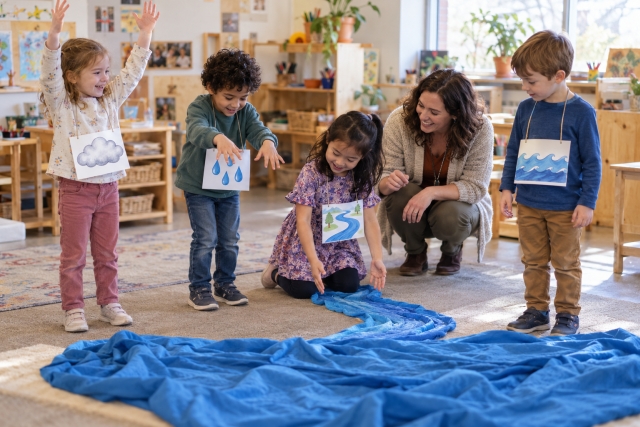
Learning goal: Children show a simple water cycle: water collects on the ground and in bodies of water, some evaporates into the air, clouds form as water vapour cools into tiny droplets, and water falls as rain.
Materials: Pictures or labels for ocean, cloud, rain, and streams or rivers; blue fabric or paper; large water tokens; and a sun picture. Mark a clear route with enough space for walking. This can be a dry activity.
Roles: Children can represent the ocean, clouds, rain, and streams or rivers, as in the example of four children acting out the cycle. Other children can move large water tokens between these places, narrate, make sound effects, or move toy figures. Rotate roles so everyone has an active contribution.
- Begin with water collected in the ocean. The ocean child holds blue fabric and several tokens. Say, “Here is some water in the ocean.”
- Show evaporation. Display the sun picture. Explain, “The sun warms the water. Some liquid water changes into water vapour and goes into the air. We cannot see water vapour.” Children carry tokens from the ocean towards the cloud area. They choose a movement to show rising. Explain that the visible tokens stand for water; real vapour is invisible.
- Show cloud formation. Say, “When water vapour cools, it can change into tiny water droplets. Many tiny droplets together form a cloud.” The cloud child gathers the tokens. For this first model, focus on droplets; clouds can also contain ice crystals.
- Show rain. Explain, “Droplets can join together and become large enough to fall as rain.” The rain child shows falling with a gesture and passes tokens down to the ground or river area. Children remain on the floor; they do not climb to make a cloud.
- Show water flowing and collecting. The stream and river children guide tokens towards the ocean. Say, “Some rainwater flows over the ground into streams and rivers, and rivers can carry it to the ocean.”
- Continue the cycle. Ask, “Where could this water go next?” Let children repeat the journey and exchange roles.
Make room for play: Children decide how to show flowing, rising, gathering, and falling. They make a landscape with fabric or blocks and choose where a river runs. After the first round, add a pond or patch of soil and let them decide where a raindrop might go. Some water can enter the soil or collect in a pond; it need not all travel straight to the ocean.
Useful prompts: “What happens to some water when it is warmed?” “How could we show rain falling?” “Where might the rainwater go?” “Can you show another journey for this token?”
Evidence of learning: Children show or describe the main connections, put simple picture cards in a sensible cycle, or explain why a token returns to the air. They do not need to memorise every scientific term.
Keep the model accurate: Clouds are made of tiny water droplets or ice crystals, rather than invisible water vapour alone. Water does not need to boil to evaporate. The sun helps warm water; it does not suck water up. The activity shows one possible route, rather than a route every raindrop must follow. These events occur in many places at the same time, and water does not complete the whole journey as quickly as the children do.
Follow-up: Observe a puddle over time or compare damp patches in different conditions. Ask children to draw a raindrop’s journey. Revisit the model if their explanations suggest that the water disappears or that clouds are containers that simply tip over.
A seed becoming a plant
Learning goal: Children show that a seed can germinate and grow into a seedling under suitable conditions.
Set-up and play: Use pictures of a seed, emerging root, shoot, and seedling. Children become seeds, using a comfortable crouched or seated pose. Others represent water and suitable warmth with pictures or gestures. The seeds show roots growing down and shoots growing up; later they spread their arms as leaves. Children choose movements and arrange a pretend garden.
Teacher support: Explain that seeds need water, air, and suitable temperatures to germinate. Once leaves develop, light supports growth. Soil can provide support and nutrients, but is not required for every seed to begin germinating.
Check and extend: Ask children to show which part appeared first in the seed they observed. Grow actual seeds and compare changes with their enactment. Explain that real growth takes days or longer and that plants do not choose to grow.
A butterfly life cycle
Learning goal: Children represent the sequence egg, caterpillar, pupa, and adult butterfly.
Set-up and play: Provide stage pictures and simple props. Children choose safe movements or use puppets to show an egg, a caterpillar feeding, a pupa, and a butterfly. The adult butterfly places an egg picture on a suitable leaf, beginning another cycle. Children can make a garden and invent a route to suitable leaves.
Teacher support: Explain that the caterpillar changes inside the pupa, also called a chrysalis. Avoid describing the pupa as merely a sleeping caterpillar. Do not wrap children in fabric; a picture or gesture can represent the stage.
Check and extend: Children arrange the pictures and show the connections. Compare their model with photographs or real observations. The changes take time, and other animals have different life cycles.
Moving water from a hill to a pond
Learning goal: Children recognise that water flows downhill when there is a downward path.
Set-up and play: Children use their arms to show slopes and move a large water token along a pretend stream. Others design a landscape with a hill, channels, and a pond. Keep children walking on level ground while the props show the height differences.
Teacher support: Ask, “Which way is downhill?” Children test their design separately with a shallow tray, gently sloping channels, and a small amount of water.
Check and extend: Children predict the direction, observe the result, and change a channel when the water does not reach the pond. Moving a token anywhere is pretend; the water test checks whether their proposed route works.
Light and shadows
Learning goal: Children notice that an object blocking light can make a shadow.
Set-up and play: Begin with a torch, opaque toy, and screen. Then let children use puppets to create a shadow story. Children representing the light source, object, and shadow can point or position picture cards to show their relationship. They test proposed arrangements with the real equipment.
Teacher support: “Where should the object go to make a shadow on the screen?” “What changes when we move it?” Use the demonstration to explain that light travels from the source and the object blocks some of it.
Check and extend: Children place the object between the source and screen and investigate changes in the shadow. Explain that a shadow is an area receiving less light, rather than a separate object that follows us. Keep lights away from eyes and avoid direct sun viewing.
A letter travelling through the post
Learning goal: Children represent a simple sequence connecting a sender and receiver.
Set-up and play: Children make a message, address an envelope with a name or picture, collect it, sort it, carry it, and deliver it. They choose roles and create a route between classroom “homes.”
Teacher support: Introduce a problem: “Two homes have the same picture. How will we know where this letter belongs?” Let children devise clearer labels.
Check and extend: Children explain or demonstrate how the message reaches the right person and why an address helps. This is a simplified postal system; actual services may organise the stages differently.
Food travelling from a garden to a meal
Learning goal: Children sequence some steps by which a familiar food reaches a meal.
Set-up and play: Choose a food such as carrots. Children create a garden, represent growing plants, harvest pretend carrots, transport them, run a shop, and prepare a pretend meal. Alternatively, small groups each manage a stage and pass the food between them.
Teacher support: “What needs to happen before we can harvest?” “How will the carrots reach the kitchen?” Children choose containers, transport, and ways to organise the work.
Check and extend: Children show a plausible sequence. Discuss a different route, such as picking food from a home garden and taking it directly to the kitchen. Not all food passes through a shop.
Guide learning without taking over the play
The teacher remains an active teacher. The amount of support depends on the children, the activity, and the learning goal. Observe, offer the help that is needed, and then return space for children to act.
- Join briefly: Enter as a customer or co-player to introduce a useful problem, then step back.
- Model when necessary: Show how to use a tool, negotiate a role, or begin an unfamiliar activity.
- Introduce vocabulary in context: Use words such as triangle, enough, float, or evaporate while children use the idea.
- Allow thinking time: Children can respond by doing something before explaining it.
- Correct misunderstandings gently: “In our game the cloud child holds tokens. A real cloud is made of many tiny droplets or ice crystals.”
- Follow useful developments: If children turn the café into a picnic, keep observing matching and quantities in the new setting.
Common problems and adjustments
- Children only repeat the teacher’s script: Keep a short introduction, then let them choose how to represent events or solve a problem.
- Only a few children have active roles: Use small groups, duplicate settings, movable toys, or supporting roles. Rotate roles without long waits.
- The activity is enjoyable but misses the goal: Change the invitation or materials so that the target skill becomes useful. If the goal is matching quantities, create customers who each need an item.
- The teacher asks too many questions: Pause, observe, and use an occasional comment or contribution instead.
- The activity demands too many skills: Simplify it. Children learning shapes need not also read labels, calculate prices, and follow complicated rules.
- A child finds the task difficult: Offer fewer items, a picture cue, a partner, an accessible prop, or a brief demonstration.
- A child is ready for more: Add a relevant challenge, such as another customer or an alternative water route, while retaining the main goal.
- A model creates a misconception: Explain what the prop stands for and use a real observation or demonstration to clarify the difference.
Prepare for safe and inclusive participation
Choose materials appropriate for the children and follow the setting’s procedures. Supervise water play closely, use shallow containers, and manage spills. Avoid small items that pose a choking risk, sharp recycled materials, climbing, and props that restrict breathing or movement. Check allergies and hygiene requirements when using food or playdough.
Keep movement routes clear and allow children to walk, move while seated, or operate a toy. Avoid making speed, loud speech, or public performance necessary for participation. Use familiar pictures and simple language. Help children negotiate roles and respect a child’s choice to observe before joining.
Plan enough time for the play to develop and for children to help tidy up. Elaborate costumes and purchased equipment are usually unnecessary. A prop only needs to help children understand and use the idea.
Notice and record learning
Look for evidence tied to the main goal. A successful performance or attractive finished product does not by itself show understanding. Notice what each child does, says, selects, changes, or explains.
- “Matched the triangle order without help.”
- “Gave one cup to each toy and noticed that a cup was missing.”
- “Predicted that the object would float, then noticed it sank.”
- “Moved the water token from the river to the ocean and explained that water flows there.”
- “Put the caterpillar before the pupa after looking at a picture cue.”
Note the support provided so that you can distinguish an independent response from one made with help. Brief notes or children’s words are often sufficient. Photographs are optional and require the setting’s permissions. Do not judge understanding only by how much a child speaks.
During the closing reflection, ask children to show one discovery, solution, or connection. For a process activity, invite them to explain a transition: “How did the water get from here to there?” Use the response to plan the next experience.
A reusable planning template
Use these questions to plan a short activity. Most answers can be one or two sentences.
- Main learning goal: What should children be able to do or understand?
- Invitation: What situation, material, or problem will invite them to play?
- Children’s actions: What will they actually do that helps them learn the goal?
- Choices: What can they decide, change, or invent?
- Materials and organisation: What props, space, group size, and time are needed?
- Participation: How can every child take part, including children who need adaptations?
- Teacher support: What short explanation, demonstration, vocabulary, or prompt might help?
- Accuracy for a process model: What does each role represent? What simplifications must be explained?
- Evidence of learning: What actions or comments will show progress? How will I note any help given?
- Reflection and next step: How will children show what they learned, and what might follow?
Final planning check: Can I point to both the intended learning and the decisions children will make? If either is missing, adjust the activity before introducing it.
 CC BY-NC-ND
This work is released under a CC BY-NC-ND license, which means that you are free to do with it as you please as long as you (1) properly attribute it, (2) do not use it for commercial gain, and (3) do not create derivative works. Link
Disclaimer: Artificial Intelligence (AI) was used in some parts of this book. If AI plagiarized your content, contact the author with evidence to initiate changes.